Synthesis of Ethers by GaBr3‐Catalyzed Reduction of Carboxylic Acid Esters and Lactones by Siloxanes
Ursula Biermann, Jürgen O. Metzger
ChemSusChem · 2014 · 10.1002/cssc.201300627
Abstract
Ethers were synthesized by reduction of the respective esters catalyzed by gallium bromide (GaBr3) and using siloxanes, preferentially 1,1,3,3‐tetramethyldisiloxane, as reductant. Methyl oleate, triglycerides, that is, tributyrine and glyceryl triundec‐10‐enoate as well as γ‐ and δ‐lactones were converted into the respective ethers in high to moderate yields. γ‐Lactones were reduced with high selectivity in the presence of a methyl ester functionality. The reduction has been carried out at room temperature or moderately elevated temperature of up to 60 °C using stoichiometric amounts of the reductant and 0.005–0.01 equiv of GaBr3 as catalyst per ester functionality without any solvent added. After a reaction time of 1–4 h the conversion of the substrate was 100 %. The product was separated from polymeric siloxanes formed as coupled product by simple distillation.
Community reviews (1)
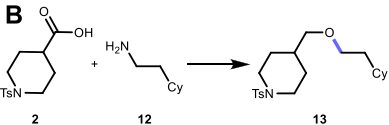
McGrath et al. reported (Amine-to-Halogen Exchange Enables an Amine–Acid Etherification) the application of the Biermann etherification conditions (1 mol% GaBr3, 1.1 equiv. TMDS, 60°C, 1 h) to compound 13 (a substrate not covered in the original work). The product was obtained in 84% crude NMR yield; under their optimised conditions (50 mol% GaI3, 25 mol% B(C6F5)3, 2.0 equiv. (MeO)3SiCl, 2.0 equiv. PhSiH3, dioxane, 65°C, 1.5 h), McGrath et al. achieved 99% on the same substrate. Reaction scale was not stated.
Save to Library
Report a bug
Describe the problem: wrong title, missing abstract, incorrect authors, or anything else that looks off.