Nickel‐Catalyzed Intramolecular C−O Bond Formation: Synthesis of Cyclic Enol Ethers
Seo‐Jung Han, Ryohei Doi, Brian M. Stoltz
Angewandte Chemie International Edition · 2016 · 10.1002/anie.201601991
Abstract
AbstractAn efficient and exceptionally mild intramolecular nickel‐catalyzed carbon–oxygen bond‐forming reaction between vinyl halides and primary, secondary, and tertiary alcohols has been achieved. Zinc powder was found to be an essential additive for obtaining high catalyst turnover and yields. This operationally simple method allows direct access to cyclic vinyl ethers in high yields in a single step.
Community reviews (1)
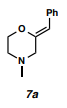
During my PhD the synthesis of 7a and 7d were investigated.
The resynthesis of 7a worked without a problem, and it was even possible to produce the compound in a clean enough form as a crude product without the need of purification.
The reaction was run under an argon atmosphere, but the Ni(COD)2 was stored in a glove box.
It was also possible to extend the chemistry described in the paper, by using a secondary amine instead of a tertiary. This gave opportunity for later modifications of the morpholine nitrogen.
We also tested the ring closure on Boc and Ts protected carbamate and sulfamid respectively, but unfortunately those reactions only led to decomposition.
The resynthesis of 7d also worked, however, instead of the reported 40% isolated yield we were only able to achieve 20% calculated yield, based on 1H-NMR.

Save to Library
Cite this paper
Loading…
Download citation file